
Corrigé BFEM Maths 2020
Exercice 1
1) La modalité qui a le grand effectif est appelée :
b) le mode
2) $-(-2)+3(0)-5<0\Rightarrow-3<0$ vrai donc $E(-2\ ;\ 0)$ appartient au demi-plan solution de l'inéquation $-x+3y-5<0$
3) On considère l'application affine $g$ définie par $g(x)=(2-\sqrt{3})x-7$
a) le coefficient de cette application est $(2-\sqrt{3})$ et l'ordonnée à l'origine $-7$
b) $g(4\sqrt{3}-5)=(2-\sqrt{3})(4\sqrt{3}-5)-7=-29+13\sqrt{3}$
\begin{eqnarray} 4)\quad A^{2}&=&\left(\dfrac{\sqrt{3}-1}{2}\right)^{2}\nonumber\\\\ &=&\dfrac{3-2\sqrt{3}+1}{4}\nonumber\\\\&=&\dfrac{4-2\sqrt{3}}{4}\nonumber\\\\\Rightarrow\;A^{2}&=&\dfrac{2-\sqrt{3}}{2} \end{eqnarray}
\begin{eqnarray} B&=&\sqrt{1-\dfrac{\sqrt{3}}{2}}\nonumber\\\\ &=&\sqrt{\dfrac{2-\sqrt{3}}{2}}\nonumber\\\\&=&\sqrt{\left(\dfrac{\sqrt{3}-1}{2}\right)^{2}}\nonumber\\\\&=&\left|\dfrac{\sqrt{3}-1}{2}\right| \end{eqnarray}
Cherchons le signe de $\dfrac{\sqrt{3}-1}{2}$
$$\left.\begin{array}{lcl} (\sqrt{3})^{2}&=&3\\\\ 1^{2}&=&1 \end{array}\right\rbrace$$
$(\sqrt{3})^{2}>1^{2}$ donc $\sqrt{3}-1>0$
d'où $\dfrac{\sqrt{3}-1}{2}>0$ donc $B=\left|\dfrac{\sqrt{3}-1}{2}\right|=\dfrac{\sqrt{3}-1}{2}$
Exercice 2
1) Sachant que l'âge moyen est de $26$ ans, montre que $m$ et $n$ vérifient le système :
$$\left\lbrace\begin{array}{lcl} m+n&=&8\\19m+27n&=&176 \end{array}\right.$$
$$\begin{array}{|l|c|c|c|c|} \hline \text{Classes}&[17\ ;\ 21[&[21\ ;\ 25[&[25\ ;\ 29[&[29\ ;\ 33[\\ \hline \text{Effectifs}&m=5&6&n=3&10\\ \hline \text{Centre de classes}&19&23&27&31\\ \hline ECC&5&11&14&24\\ \hline FCC(\%)&20.8&45.8&58.3&100\\ \hline \end{array}$$
$-\ m+6+n+10=24\Rightarrow\;m+n=24-16=8$
$\begin{array}{lll} -\ \text{moy}&=&\dfrac{19m+23\times 6+27n+31\times 10}{24}\\\\&=&26\\\\\Rightarrow\dfrac{19m+138+27n+310}{24}&=&26\\\\\Rightarrow\;19m+27n+448&=&624 \end{array}$
D'où $19m+27n=624-448=176$ donc $m$ et $n$ vérifient le système
$$\left\lbrace\begin{array}{lcl} m+n&=&8\\\\ 19m+27n&=&176 \end{array}\right.$$
Après résolution on trouve $m=5$ et $n=3$
2) Pour la suite de l'exercice, on donne : $m=5$ et $n=3.$
a) voir tableau.
b) le nombre de mères ayant moins de $29$ ans à la naissance de leur premier enfant :
c) la fréquence des mères ayant au moins $25$ ans à la naissance de leur premier enfant est :
$f=\dfrac{3+10}{24}$
3) a) voir figure
b) âge médian en utilisant le théorème de Thalès :
$\dfrac{me-25}{4}=\dfrac{12-11}{3}\Rightarrow\;me=26.3$
Exercice 3
Une pyramide régulière $SABCD$ à base carrée de hauteur $SO=\sqrt{34}m$ représente la charpente du toit d'un hangar. La longueur de l'arête $SA=\sqrt{34}m$
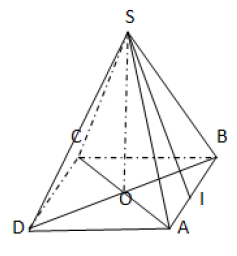
\begin{eqnarray} 1)\quad OA^{2}&=&SA^{2}-SO^{2}\nonumber\\\\\Rightarrow\;OA^{2}&=&34-16\nonumber\\\\&=&18\nonumber\\\\\text{donc }OA&=&\sqrt{18}\nonumber\\\\&=&3\sqrt{2} \end{eqnarray}
\begin{eqnarray} AB^{2}&=&2OA^{2}\nonumber\\\\\Rightarrow\;AB^{2}&=&2\times 18\nonumber\\\\&=&36\nonumber\\\\\text{donc }AB&=&\sqrt{36}\nonumber\\\\&=&36 \end{eqnarray}
2) Le volume de cette pyramide
\begin{eqnarray} V&=&\dfrac{AB^{2}\times SO}{3}\nonumber\\\\&=&\dfrac{36\times 4}{3}\nonumber\\\\&=&48\,m^{3} \end{eqnarray}
3) Aire latérale
$A_{L}=\dfrac{\text{Périmètre de base}\times\text{apothème}}{2}$
Calcul de l'apothème $SI$
$SIA$ rectangle en $I$
\begin{eqnarray} \text{donc }SI^{2}&=&SA^{2}-IA^{2}\nonumber\\\\&=&34-9\nonumber\\\\&=&25\nonumber\\\\\Rightarrow\;SI&=&\sqrt{25}\nonumber\\\\&=&5 \end{eqnarray}
$A_{L}=\dfrac{4\times 6\times 5}{2}$
le prix d'achat des tôles nécessaires à la construction de la toiture
$\text{Prix}=60\times 3000\ F=180\ 000\ F.$
Exercice 4
1) Choisis la bonne réponse
a) Si $F$ est le symétrique de $E$ par rapport à $A$ alors : $\overrightarrow{AF}=\overrightarrow{EA}$
b) Si $E$ est le milieu de $[AB]$ alors : $\overrightarrow{AE}=-\dfrac{1}{2}\overrightarrow{BA}$
2) On donne les vecteurs $\overrightarrow{u}(\begin{pmatrix} e\\ f \end{pmatrix})$ et $\overrightarrow{v}(\begin{pmatrix} a\\ b \end{pmatrix}).$
$\overrightarrow{u}$ et $\overrightarrow{v}$ sont colinéaires équivaut à : $eb-af=0.$
3) Dans un repère orthonormal $(O\;,\ \vec{I}\ ;\ \vec{J})$ place les points $A(-1\ ;\ 1)$ ; $B(3\ ;\ -1)$ et $C(5\ ;\ 3)$
a) Coordonnées des vecteurs $\overrightarrow{AB}$ ; $\overrightarrow{AC}$ et $\overrightarrow{BC}$
$\overrightarrow{AB}\begin{pmatrix} 4\\ -2 \end{pmatrix}$ ; $\overrightarrow{AC}\begin{pmatrix} 6\\ 2 \end{pmatrix}$ et $\overrightarrow{BC}(\begin{pmatrix} 2\\ 4 \end{pmatrix}$
b) Montrons que le triangle est rectangle.
Vérifions que les vecteurs $\overrightarrow{AB}(\begin{pmatrix} 4\\ -2 \end{pmatrix}$ et $\overrightarrow{BC}\begin{pmatrix} 2\\ 4 \end{pmatrix}$ sont orthogonaux.
$4\times 2+(-2)\times 4=8-8=0$
donc $\overrightarrow{AB}(\begin{pmatrix} 4\\ -2 \end{pmatrix}$ et $\overrightarrow{BC}(\begin{pmatrix} 2\\ 4 \end{pmatrix}$ sont orthogonaux d'où $ABC$ rectangle en $B$
c) Calcule les coordonnées du point $D$ image de $A$ dans la translation de vecteur $\overrightarrow{BC}$
Soit $D(x\ ;\ y).$ $D$ image de $A$ dans la translation de vecteur $\overrightarrow{BC}$ donc $\overrightarrow{AD}=\overrightarrow{BC}$
$\overrightarrow{AD}\begin{pmatrix} x+1\\ y-1 \end{pmatrix}=\overrightarrow{BC}\begin{pmatrix} 2\\ 4 \end{pmatrix}$
$\Rightarrow\left\lbrace\begin{array}{lcl} x+1&=&2\\y-1&=&4 \end{array}\right.$
$\Rightarrow\left\lbrace\begin{array}{lcl} x&=&1\\y&=&5 \end{array}\right.$
donc $D(1\ ;\ 5)$
d) Soit $(\mathcal{C})$ le cercle circonscrit au triangle $ABC.$
$E$ est milieu de $[AC]$ d'où $E\left(\dfrac{-1+5}{2}\ ;\ \dfrac{1+3}{2}\right)$ $E(2\ ;\ 2)$
Équation de la droite $(L)$ tangente au cercle en $B.$
Soit $M(x\ ;\ y)$ un point de $(L)$
$\overrightarrow{BM}$ et $\overrightarrow{BE}$ sont orthogonaux
$\overrightarrow{BM}\begin{pmatrix} x-3\\ y+1 \end{pmatrix}$ et $\overrightarrow{BE}\begin{pmatrix} -1\\ 3 \end{pmatrix}$ sont orthogonaux donc $-1(x-3)+3(y+1)=0$
$\begin{array}{lcl} -x+3+3y+3&=&0\\\\\Rightarrow\;(L)&=&-x+3y+6\\\\&=&0 \end{array}$
Ajouter un commentaire